
Category: Scholarships
Published by: StudentRoute PK
Information reviewed: November 8, 2026
Every year, Pakistani students search for scholarships to support their education at universities in Pakistan and abroad. Financial assistance can make a significant difference for students who struggle with tuition fees, accommodation, and other educational expenses.
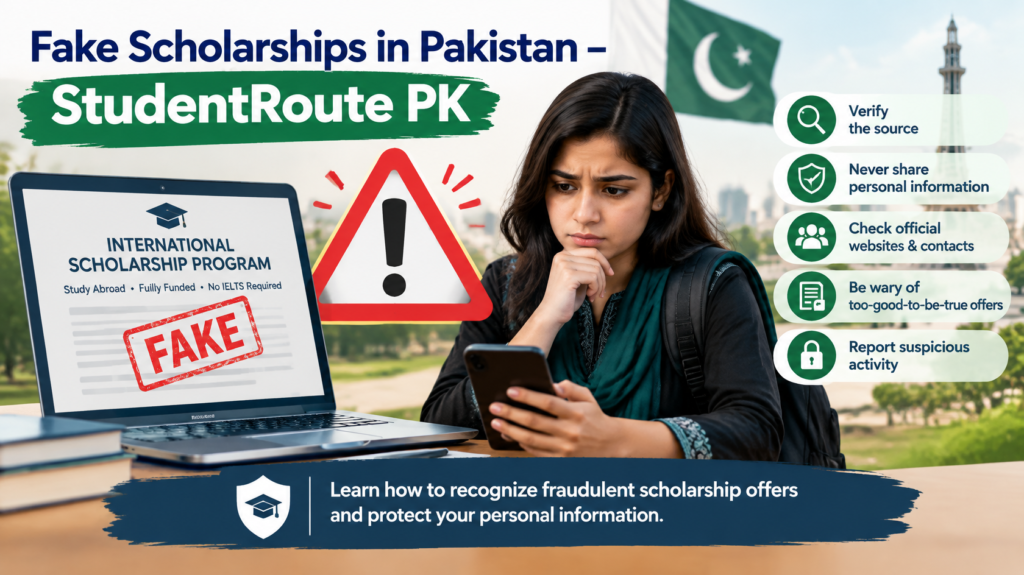
Unfortunately, scammers can exploit students’ hopes by advertising fake scholarships, creating misleading websites, impersonating educational institutions, or demanding money for supposed application processing.
A scholarship advertisement may appear on WhatsApp, Facebook, Instagram, or another online platform and claim to offer financial assistance from a well-known organization.
But how can students determine whether an opportunity is genuine?
This guide explains how to identify fake scholarships in Pakistan, recognize common warning signs, verify Higher Education Commission (HEC) announcements, and report suspicious activity.
1. What Is a Fake Scholarship?
A fake scholarship is a fraudulent opportunity advertised to deceive students or obtain their money, personal information, or account credentials.
Scammers may pretend to represent universities, government departments, international organizations, or legitimate scholarship providers.
Their objective may be to collect application payments, steal sensitive information, or gain access to online accounts.
Some fraudulent advertisements imitate real scholarship programmes. Others promote entirely invented opportunities.
A professional-looking advertisement is not proof that a scholarship is genuine.
2. Why Students Should Be Careful
Students applying for scholarships may be asked to provide sensitive information, including:
- Full name and contact information.
- CNIC or B-Form details.
- Academic records.
- Household financial information.
- Passport details.
- Account registration information.
These documents can be necessary for legitimate applications, but submitting them through a fraudulent website could expose students to identity theft, phishing, or financial fraud.
HEC has issued an official public warning about fraudulent websites, scam phone calls, and individuals pretending to be associated with its services.
Students should therefore confirm opportunities independently before making payments or sharing sensitive information.
Official source: HEC Public Alert About Fraudulent Websites and Online Scams.
3. Ten Warning Signs of Fake Scholarships
1. Guaranteed Scholarship Approval
Be cautious of advertisements promising that every applicant will receive a scholarship.
Genuine scholarship programmes generally have eligibility requirements, application procedures, and selection rules.
An individual promising guaranteed selection in exchange for payment is a major warning sign.
2. Requests for Money Through Personal Accounts
Some scammers ask students to send payments to a personal bank account, mobile wallet, or unfamiliar recipient.
A legitimate scholarship programme may charge an official application or testing fee, so the existence of a fee alone does not prove fraud.
However, students should verify the fee amount, payment method, and recipient through the programme’s official announcement.
Never send money simply because an unknown person claims to be a scholarship representative.
3. Suspicious Website Addresses
Fraudulent websites may use addresses resembling those of legitimate organizations.
For example, an attacker might add extra words, letters, or unusual endings to a familiar institution’s name.
Always inspect the complete web address.
For HEC information, begin with the official website:
Follow application links published on verified HEC programme pages rather than relying on unfamiliar links shared in messages.
4. Requests for Passwords or OTP Codes
A scholarship representative should not need your personal email password, banking password, or one-time verification code.
HEC specifically warns against sharing passwords, OTPs, banking details, and other sensitive information through suspicious websites or telephone calls.
Never provide an OTP to someone contacting you unexpectedly.
5. Extremely Urgent Payment Demands
Scammers may create pressure by saying:
- “Pay within one hour.”
- “Your scholarship will be cancelled unless you transfer money.”
- “Only a few seats remain, so send your fee immediately.”
Scholarships can have genuine deadlines, but pressure to send money to an unverified account is suspicious.
Confirm the announcement independently before taking action.
6. No Official Scholarship Announcement
A scholarship advertised only through social media, with no verifiable announcement from its supposed provider, deserves additional scrutiny.
Search the relevant university, government department, or scholarship provider’s official website.
If the provider cannot confirm the opportunity, do not submit sensitive information.
7. Fake Selection Letters
Fraudsters may distribute letters claiming that a student has already been selected.
These documents might include copied institutional logos, signatures, or official-looking stamps.
A selection letter should be verified through the issuing institution’s official contact details or application system.
Do not rely on a phone number printed on a suspicious letter without checking it independently.
8. Poorly Explained Eligibility Requirements
A genuine scholarship announcement should ordinarily provide enough information for students to understand who can apply and how applications are evaluated.
Be cautious when an advertisement promises substantial funding but provides no meaningful eligibility criteria, application process, or administering organization.
Incomplete information is not definitive proof of fraud, but it is a reason to investigate further.
9. Unverified WhatsApp or Social Media Representatives
A person using an organization’s name or logo on WhatsApp is not automatically an authorized representative.
Scammers can copy profile photographs, scholarship posters, and institutional branding.
Verify any representative’s identity using contact details published by the actual organization.
10. Requests for Unnecessary Sensitive Documents
Scholarship providers may legitimately need identification and academic records.
However, a suspicious website asking for banking passwords, payment-card security codes, or unrelated personal information should not be trusted.
Only submit documents required by the official application procedure.
4. How to Verify an HEC Scholarship
You can reduce the risk of fraud by using a consistent verification process.
Step 1: Open the Official HEC Website
Enter the website address directly into your browser:
Avoid beginning with an unfamiliar link received in a social media message.
Step 2: Find the Scholarship Directory
Visit the official HEC Scholarship Directory.
Search for the relevant scholarship or browse its category.
The directory contains national programmes, international opportunities, fellowships, and support schemes.
Step 3: Read the Programme Announcement
Open the specific programme’s official information page.
Check the eligibility requirements, application procedure, contact information, and academic year.
Some scholarship pages remain online after applications have closed.
An opportunity appearing in the directory does not necessarily mean that a current intake is open.
Step 4: Verify the Application Portal
Different HEC programmes can use different application systems.
HEC’s official online services portal for matters such as degree-related services is:
For certain scholarship programmes, HEC’s official announcements direct applicants to:
Other programmes require applications through a university’s Financial Aid Office or an external scholarship provider.
Use the portal specified in the current official announcement for your particular scholarship.
Step 5: Check the Deadline and Application Fee
Verify the application period using the original announcement.
If an application or testing fee is required, confirm its amount and payment instructions.
Never assume that every HEC programme has the same fee or submission requirements.
Step 6: Contact the Official Organization
If you still have doubts, contact HEC or the relevant scholarship administrator using contact information from its official website.
Do not rely solely on phone numbers or email addresses supplied in an unverified advertisement.
For a practical explanation of HEC scholarship types, read our HEC Scholarships in Pakistan guide.
5. Example: Recognizing a Suspicious Scholarship Advertisement
Consider this fictional scenario.
A student receives a WhatsApp message claiming:
“You have been selected for an international scholarship. Send Rs. 3,000 immediately to confirm your seat.”
The message includes a university logo and a link to an unfamiliar website.
Before responding, the student should ask several questions:
- Did I actually apply for this scholarship?
- Can I locate the same announcement on the provider’s official website?
- Does the scholarship provider confirm that I have been selected?
- Is the requested payment part of the official application procedure?
- Why is the payment being requested through an unfamiliar contact?
If the student cannot verify the offer, they should not send money or documents.
This example illustrates common warning signs. It does not suggest that every scholarship involving a fee is fraudulent.
6. Are All Scholarships With Application Fees Fake?
No.
Some legitimate scholarship or university application processes involve official testing fees, processing fees, or other charges.
The important question is whether the payment is genuine, authorized, and clearly described in the official instructions.
Before paying:
- Check the scholarship provider’s official website.
- Confirm the exact amount.
- Verify the designated payment method.
- Check the recipient’s identity.
- Keep an official payment receipt.
- Avoid informal promises of guaranteed approval.
Do not make payments to an unrelated individual claiming to influence scholarship selection.
7. How to Protect Your Personal Documents
Students often prepare digital copies of CNICs, transcripts, certificates, income records, and other documents for scholarship applications.
These files deserve careful handling.
Use Official Application Websites
Upload sensitive documents only through the approved application process.
Avoid Unknown File-Sharing Requests
Do not send complete scholarship documents to strangers through messaging applications.
Keep Documents in Secure Storage
Use a password-protected device and a secure account to store important records.
Check Before Sharing Screenshots
When asking for help with an application, conceal personal information that does not need to be visible.
Protect Login Credentials
Use strong, unique passwords and enable multi-factor authentication where available.
Do not reuse your email password on unfamiliar scholarship websites.
8. What to Do If You Have Already Shared Information With a Scam Website
If you believe you entered information into a fraudulent scholarship website, act promptly.
Stop Further Contact
Do not send additional payments, passwords, or documents.
Secure Your Accounts
If you entered a password, change it immediately using the legitimate service’s website.
Change the same password anywhere else you reused it.
Enable multi-factor authentication where possible.
Contact Your Bank or Payment Provider
If you transferred money or disclosed financial credentials, contact the relevant bank or payment provider through its official support channel.
Explain what happened and ask what steps are available to protect your account or report the transaction.
Preserve Evidence
Save relevant messages, website addresses, transaction details, and screenshots.
Avoid publicly sharing evidence containing sensitive personal information.
Report the Incident
In Pakistan, suspected cybercrime can be reported to the National Cyber Crime Investigation Agency (NCCIA).
Use the official complaint system:
The NCCIA also publishes information about reporting centres and complaint procedures on its website.
Reporting does not guarantee that money can be recovered, but it provides authorities with information for reviewing the incident.
9. How to Report a Fake Scholarship in Pakistan
If a website or advertisement is impersonating an educational institution, consider reporting it through the relevant channels.
Report HEC Impersonation
If the suspicious website claims to represent HEC, use HEC’s official website to locate its support and complaint channels.
Include the suspicious website address and a brief description of the impersonation.
Report Cybercrime to NCCIA
Visit the NCCIA complaint portal.
The official complaint form requests identification and contact details, along with information about the incident.
Submit accurate information and retain any complaint reference number.
NCCIA also lists its helpline as 1799.
Report the Advertisement to the Platform
If you encountered the advertisement on Facebook, Instagram, WhatsApp, or another service, use its built-in reporting features.
This can help the platform review misleading content.
Inform the Impersonated Organization
If an advertisement misuses a university’s or scholarship provider’s identity, notify the organization through its official contact details.
10. Five-Minute Scholarship Verification Checklist
Before submitting any scholarship application, complete this quick check.
| Question | What to verify |
|---|---|
| Is the scholarship real? | Find an official announcement |
| Is the application currently open? | Check the current deadline |
| Am I eligible? | Read the actual programme criteria |
| Is the application website genuine? | Follow the official provider’s link |
| Are fees or documents being requested correctly? | Confirm official instructions |
If you cannot verify an important detail, pause the application and contact the provider directly.
11. Frequently Asked Questions
How can I check whether an HEC scholarship is real?
Search for the scholarship through HEC’s official website and read the relevant programme announcement. Confirm its application procedure and current status.
Is every scholarship shared on WhatsApp fake?
No. Legitimate announcements may be shared through WhatsApp.
However, a forwarded message is not sufficient proof. Verify the announcement independently.
Can a fake website have HTTPS?
Yes. An HTTPS connection means information is encrypted in transit, but it does not prove that a website or scholarship offer is legitimate.
Always verify the site’s identity and the original announcement.
Should I pay someone to guarantee scholarship selection?
No. Be extremely cautious of anyone promising guaranteed approval in exchange for payment.
Selection decisions belong to the responsible scholarship organization.
Can I report a fraudulent scholarship website?
Yes. You can submit relevant information to NCCIA and notify the institution being impersonated.
What if I already sent my CNIC to a suspicious website?
Stop sharing further information, preserve evidence, and report the incident through official channels. If other account credentials or financial information were compromised, secure those accounts immediately.
Where can I find genuine scholarship opportunities?
Begin with official government, university, and scholarship-provider websites.
For HEC programmes, use the official scholarship directory and programme announcements.
12. Official Resources
The following sources provide useful information about scholarships and online safety:
- HEC Official Website
- HEC Scholarship Directory
- HEC Public Alert on Fraudulent Websites and Scams
- HEC Online Services Portal
- NCCIA Official Website
- NCCIA Cybercrime Complaint Portal
Conclusion
Scholarship opportunities can make a meaningful difference in a student’s educational journey, but applicants should be cautious about fraudulent advertisements and impersonation attempts.
The safest approach is to start with the original scholarship provider, check the current announcement, verify the application website, and confirm any required fees or documents.
Never share passwords, OTP codes, or sensitive financial information with an unverified person.
A genuine scholarship opportunity should be independently verifiable through the organization responsible for it.
StudentRoute PK encourages Pakistani students to research carefully, protect their information, and use official application channels.
Editorial Note: This article was prepared using official HEC scam advisories, scholarship information, and NCCIA reporting guidance reviewed on November 8, 2026. Reporting procedures and website addresses may change.
Disclaimer: StudentRoute PK is an independent educational information website and is not affiliated with HEC, NCCIA, or any scholarship-awarding organization.