
Category: Scholarships
Published by: StudentRoute PK
Information reviewed: November 8, 2026
For many students in Pakistan, obtaining admission to a university is an achievement, but paying tuition fees and meeting educational expenses can be another major challenge.
The HEC Need-Based Scholarship Programme aims to help financially disadvantaged students continue their higher education at selected participating universities in Pakistan.
Unlike scholarships awarded primarily for academic excellence, this programme considers students’ family financial circumstances, although admission requirements and the scholarship’s selection process still apply.
Students often have important questions: Who is eligible? Is there a minimum CGPA? How much financial assistance is provided? Can students already enrolled at university apply? And where should applications be submitted?
This guide explains the HEC Need-Based Scholarship eligibility criteria, financial benefits, application procedure, selection process, and common mistakes students should avoid.
Important: This is an informational guide, not an announcement of an open application period. Participating universities announce their own application dates. Always confirm the current intake with your university’s Financial Aid Office.
1. What Is the HEC Need-Based Scholarship?
The HEC Need-Based Scholarship Programme is a financial assistance initiative associated with Pakistan’s Higher Education Commission.
Its purpose is to support eligible students whose financial circumstances make it difficult to complete university education.
The programme operates through selected participating public-sector universities and degree-awarding institutions.
Rather than accepting individual applications directly, HEC works through participating institutions, which receive applications and assess eligible candidates.
Students can use the scholarship to help reduce the financial burden of tuition and other education-related expenses within the programme’s published terms.
Official information is available on the HEC Need-Based Scholarships website.
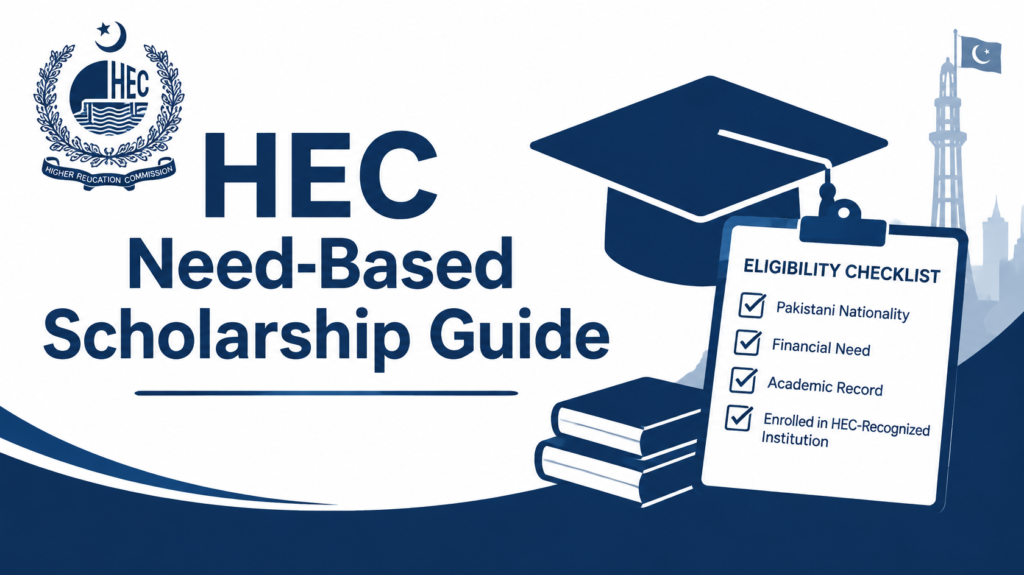
2. Who Is Eligible for the HEC Need-Based Scholarship?
The current dedicated HEC eligibility page describes support for eligible undergraduate students attending participating public-sector institutions.
The main conditions include the following.
Undergraduate Enrolment
Applicants should be admitted to or enrolled in an eligible undergraduate programme at a participating university.
The current published criteria describe four- and five-year undergraduate programmes.
Certain professional degrees, including medicine and Pharm-D, are specifically mentioned within the five-year programme arrangements.
Participating University
The applicant must attend an institution covered by the scholarship programme.
Being enrolled at a university recognized by HEC does not automatically mean the institution participates in this particular scholarship.
Students should verify participation through the official HEC list and their university’s Financial Aid Office.
Demonstrated Financial Need
Financial need is central to the programme.
Applicants provide information about family income, financial circumstances, educational costs, and other relevant household details.
The Institutional Scholarship Award Committee evaluates these circumstances when considering applications.
Regular Admission Category
The published HEC eligibility rules state that students admitted on a self-finance basis are not eligible under this programme.
Students unsure about their admission category should request confirmation from their university.
Existing University Students
Students already studying at a participating institution may also apply, provided they satisfy the applicable conditions and the university is accepting applications.
It is not limited exclusively to newly admitted first-semester students.
Important eligibility clarification: Some older HEC pages refer to postgraduate scholarships under an earlier description of the programme. The current dedicated Need-Based Scholarship eligibility page focuses on undergraduate study. Postgraduate applicants should confirm eligibility directly with HEC or their university rather than relying on an older page.
Official reference: HEC Eligibility Criteria.
3. How Much Financial Support Does the Scholarship Provide?
According to the current HEC eligibility and financial-support pages, the programme provides support relating to:
- University tuition fees.
- A monthly stipend for selected scholarship recipients.
The published eligibility page lists a stipend of Rs. 6,000 per month, in addition to university fee support.
The scholarship is designed to cover the eligible duration of a student’s programme, subject to the programme’s requirements and institutional administration.
However, students should not assume that every applicant receives financial assistance.
The number of scholarship places depends on available funding, university allocations, and the selection process.
The university should confirm the applicable financial benefits, award conditions, and payment arrangements.
Official reference: HEC Financial Support.
4. Is There a Fixed Family Income Limit?
Students frequently ask whether there is a specific household income threshold.
The current HEC Need-Based Scholarship eligibility page does not publish one universal rupee amount that automatically determines eligibility at every participating university.
Instead, financial need is assessed by the Institutional Scholarship Award Committee.
Institutions may publish additional conditions for a particular intake.
For example, a university might request particular income documents or specify the financial criteria for its available scholarship places.
Students should therefore avoid relying on an unofficial income figure shared on social media.
Ask the participating institution about the financial criteria applicable to the current application cycle.
5. How to Apply for HEC Need-Based Scholarship: Step by Step
The application process begins at the participating university.
Step 1: Confirm University Participation
Contact your university’s Financial Aid Office and ask whether the HEC Need-Based Scholarship Programme is currently available.
You should confirm:
- Whether your university participates.
- Whether your degree programme is eligible.
- Whether your admission category qualifies.
- Whether applications are currently being accepted.
- What deadline applies.
- Whether an online form, printed form, or both are required.
Step 2: Obtain the Application Form
HEC provides an application form through its official website.
Students may also obtain the current form from their university’s Financial Aid Office.
Use the version specified by your institution.
Visit the HEC Scholarship Downloads page.
Step 3: Complete Personal and Educational Details
Fill in the information requested on the form.
This may include personal identification details, contact information, university information, degree programme, and educational background.
Make sure details are consistent with your official records.
Step 4: Provide Accurate Financial Information
The application asks about household financial circumstances.
Depending on the form and university requirements, applicants may need to explain family income, expenses, assets, dependants, and education-related costs.
Consult your parents or guardians where appropriate so the information is accurate.
Never exaggerate financial hardship or submit false financial records.
Step 5: Prepare Supporting Documents
Gather all documents required by your university’s current application checklist.
Typical records may include identity documents, income evidence, utility bills, fee receipts, and other relevant financial documents.
The complete requirements depend on the applicable form and university instructions.
Step 6: Submit to the University
Submit the completed application through the method specified by your university’s Financial Aid Office.
Do not send the application directly to HEC.
HEC’s published application instructions explicitly direct students to participating institutions.
Step 7: Complete Any Verification or Interview
Depending on the selection process, applicants may be asked to clarify information or provide additional evidence.
Respond through official university channels and provide truthful, consistent answers.
Step 8: Follow the Award Announcement
The university reviews applications and communicates relevant decisions according to its process.
A submitted application does not guarantee selection.
Retain a copy of your application and any acknowledgement for future reference.
Official reference: HEC How to Apply.
6. Documents Commonly Required
The published HEC Need-Based Scholarship application checklist includes documents such as:
| Document | Purpose |
|---|---|
| Parent/guardian CNIC copies | Family identification |
| Parent/guardian salary certificates | Household income assessment |
| Utility bills covering the previous six months | Household expense evidence |
| Rent agreement, if applicable | Housing expense verification |
| Recent education fee receipts | Educational expenditure |
| Medical expense records, if applicable | Relevant household expenses |
| Previous scholarship records, if applicable | Financial assistance history |
| Statement of purpose | Applicant’s explanation of suitability |
Some universities may require additional records such as academic transcripts, domicile information, photographs, or other documents.
Always follow the university’s current checklist.
For further preparation guidance, read StudentRoute PK’s article on documents required for scholarship applications in Pakistan.
Official reference: HEC Need-Based Scholarship Downloads.
7. How Are Students Selected?
Selection is not based simply on who submits an application first.
HEC describes a review process involving the Institutional Scholarship Award Committee (ISAC).
The committee considers applicants and their supporting information to determine scholarship recommendations.
Assessment of Financial Need
Applicants’ family financial circumstances are reviewed.
Income, expenses, dependants, and other relevant circumstances may help the institution understand the family’s ability to pay educational costs.
Verification of Information
Applications and supporting records may be checked for accuracy.
The scholarship application form warns that false information can lead to serious consequences.
Applicants should ensure that all declarations and documents are genuine.
Committee Review
The Institutional Scholarship Award Committee reviews eligible applications and prepares recommendations.
HEC’s award-process page describes a committee headed by the participating institution’s Vice Chancellor, with institutional and external members.
Award Finalization
After the awardees are finalized, scholarship funding is administered through the participating university.
The scholarship is not awarded simply because an applicant has submitted a complete form.
Official reference: HEC Scholarship Award Process.
8. When Is the Application Deadline?
There is no single nationwide deadline that applies to every participating university.
HEC’s programme FAQ explains that participating universities are responsible for announcing their own application opening and closing dates.
For example, COMSATS University Islamabad’s Lahore Campus announced an HEC Need-Based Scholarship application deadline of October 15, 2026, for its Fall 2026 intake.
That deadline has already passed. It is included here only as an example of a university-specific schedule, not as a currently open opportunity.
Students at other institutions should check their own university announcements rather than assuming COMSATS dates apply everywhere.
A practical approach is to check your university’s Financial Aid Office announcements at the beginning of each semester.
9. Can Students Already Enrolled Apply?
Yes. HEC’s current guidance permits financially constrained students already enrolled in participating institutions to apply.
For example, a student entering the third semester of an eligible undergraduate programme may still be considered when the university accepts applications.
However, an award does not automatically cover tuition or expenses from earlier semesters.
HEC’s FAQ explains that scholarship funds are provided from the date of the award rather than retroactively from the date of university enrolment.
Students should confirm the relevant financial arrangements with their institution.
10. Can You Receive Another Scholarship at the Same Time?
HEC’s Need-Based Scholarship FAQ states that students already receiving financial assistance or scholarships from their university or institution are not eligible under this programme.
Applicants should disclose existing financial support honestly.
If you receive a fee concession, another scholarship, or a different kind of financial assistance, ask the university whether it affects your eligibility.
Do not assume that every form of financial support is treated identically without checking the programme rules.
11. Practical Example: Applying Through a University
Consider a fictional student named Ahmed.
Ahmed is enrolled in the second semester of a four-year undergraduate programme at a participating public-sector university.
His family has difficulty covering tuition and transportation expenses.
Instead of submitting an application directly to HEC, Ahmed follows these steps:
- Visits his university’s Financial Aid Office.
- Confirms that applications are being accepted.
- Checks that his admission category is eligible.
- Collects the official scholarship form.
- Prepares accurate family income and expense information.
- Attaches supporting documents.
- Submits the application before the university’s deadline.
- Responds to any verification requests.
- Waits for the university’s official selection decision.
This example demonstrates the process, not a guarantee that Ahmed will receive a scholarship.
12. Common Mistakes to Avoid
Applying to HEC Instead of the University
For this programme, applications must go through the participating institution’s Financial Aid Office.
Assuming Every University Participates
HEC recognition and scholarship participation are not the same thing.
Verify that your institution is eligible under the programme.
Using an Expired Deadline
An older scholarship announcement may remain visible online after its application window closes.
Always check the academic year and deadline.
Applying Under an Ineligible Admission Category
Students admitted on self-finance are excluded under the current published eligibility rules.
Confirm your admission category before preparing the full application.
Providing Incomplete Financial Information
Applications may be delayed or rejected if essential financial records are missing or inconsistent.
Review the official checklist before submitting.
Assuming Selection Is Guaranteed
Meeting the basic conditions does not guarantee an award.
Available funding and institutional assessment affect selection.
13. Frequently Asked Questions
Is HEC Need-Based Scholarship available for BS students?
Yes. The current dedicated eligibility page focuses on eligible undergraduate programmes at selected participating institutions.
Can first-semester students apply?
Eligible newly admitted students can apply when their university opens applications, subject to institutional requirements.
Can third-semester students apply?
Yes, existing students may apply if they meet the programme conditions.
Are self-finance students eligible?
No. The current HEC eligibility criteria exclude students admitted on a self-finance basis.
Is there a minimum CGPA?
The central HEC Need-Based eligibility page does not specify one universal CGPA threshold for every institution and intake.
Students must meet admission and other applicable academic requirements. Ask the university whether any performance or continuation conditions apply.
What is the monthly stipend?
HEC’s currently published eligibility page lists Rs. 6,000 per month for scholarship recipients, alongside university fee support.
Confirm the applicable benefit and payment arrangements with the participating university.
Can students from affiliated colleges apply?
HEC’s programme FAQ states that affiliated colleges of participating universities are not covered under this particular scholarship.
Can the scholarship be transferred to another university?
HEC’s FAQ states that the award is not transferable between participating institutions.
Is the scholarship application submitted online?
The university determines the application method for its intake.
Some institutions may use online data collection alongside printed documentation, while others follow different administrative procedures.
Students should follow the relevant Financial Aid Office instructions.
When does the application open?
Participating universities announce their own dates. Check your institution’s current notice.
Can a student with only a matriculation qualification apply?
Not directly under the current undergraduate scholarship criteria. The student must meet university admission and enrolment requirements for an eligible programme.
14. Official HEC Resources
Students can verify programme information using the following sources:
- HEC Need-Based Scholarship Overview
- HEC Eligibility Criteria
- HEC How to Apply
- HEC Application Form and Downloads
- HEC Scholarship Award Process
- HEC Frequently Asked Questions
Conclusion
The HEC Need-Based Scholarship Programme can provide valuable support to eligible undergraduate students facing financial difficulties at participating Pakistani universities.
The most important steps are to confirm that your institution and degree programme qualify, understand the current financial-assistance conditions, prepare genuine supporting documents, and submit the application through your university’s Financial Aid Office.
Students should not depend on expired announcements, unofficial application links, or promises of guaranteed selection.
By following the official process and preparing accurate information, applicants can avoid common mistakes and make a properly documented scholarship application.
For a broader explanation of available opportunities, read StudentRoute PK’s HEC Scholarships in Pakistan guide.
Editorial note: Information reviewed on November 8, 2026, using official HEC programme pages and university notices. Eligibility, funding, deadlines, and university procedures may change. Students must confirm the rules applicable to their own institution and application period.
Disclaimer: StudentRoute PK is an independent educational information website. We are not affiliated with HEC and do not award scholarships or process applications on behalf of participating universities.